Search

12 Books in 12 Months

writing books and blogging about it

When Can I Read A Whole One?

For those interested in the more practical aspects of this project, such as when you will get to read a finished version of one of these books, I say this:

Because book 13 is going to be partly about the adventures of trying to get published, I suspect I shouldn’t put full manuscripts online until they have been definitively ignored/rejected by… oh, I don’t know, 30 publishers?   After all, who is going to publish something you can already download as a free PDF?  We’ve all seen enough of The Apprentice / Dragon’s Den to know this does not make good business sense.

Furthermore, I would like the opportunity to go back over them all, so that what is eventually available in its entirety for you to read online is something faintly more polished than a first draft.  But, the editing process can be a long and harrowing one.  Who knows what my tired brain will make of Caligula’s blog when I go back over it after writing eleven books in totally different fields?   So at the moment, I can’t really get a handle on how long that’s going to take.

For debut author Julia Crouch, who, like me, found her inspiration in NaNoWriMo, there was a gap of over two years between bashing out that first draft (which she did in November 2008) and getting it published (which will happen in March this year).  You can read an interview with her on the subject here.

What I’m saying is, I don’t yet have a definitive date for you to be able to read any of the 12 books.  Although I may yet decide to email people first drafts as part of some sort of competition scenario, or reward for getting involved.

Flaming Fields

Today I had my first negative experience of the 12 books in 12 months project, when someone on Twitter took exception to my suggestion that people ‘like’ the Facebook Group.  “Sincerely, fuck you,” quoth he.  “Not everyone is a drooling facebook cretin.”

Constructive criticism, how I have longed for thee.

I appreciate Facebook is annoying in a lot of ways.  But in terms of publicizing a project which will probably die on its arse if I can’t get people to interact, it’s potentially very useful.  It’s also a good forum for posting links for those people who don’t use Twitter – including the majority of my friends. So frankly, this chap can piss away aff.

I’ve read a few comments of late about the fact people think it’s OK to be needlessly rude on the internet in a way that you wouldn’t be in real life, and I suppose this is another example.  I won’t be losing sleep over it, but naturally it’s irritating.  And I am supposed to be recording everything for the posterity of book 13, so there it is.

In news more in-keeping with the predominantly positive tone of the project, Rebecca Jamieson of Informed Edinburgh interviewed me last week and her article is now live here, complete with somewhat poser-y photo.  Meanwhile, in Italy, police found Caligula’s tomb when some guys tried to nick a statue from it.  This is surely the butterfly effect, sparked off by my research for book one.  Or not.

A Call To Arms

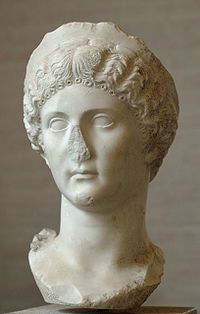
Family was very important to Caligula, to the extent that he had most of them deified (ie worshipped as gods), he put them on coins, and he had the senate swear allegiance to his sisters as well as to him.

His favourite was meant to have been Julia Drusilla – the only one who probably wasn’t involved in a plot to kill him, to give her her due – to the extent that the gossipy so and so’s who wrote the historical sources closest to the period accused him of having an incestuous relationship with her.  Certainly he was very cut up when she died, but although he made a massive fuss and ordered the entire empire into mourning, that wasn’t without precedent.

Anyway, whether he loved her in a wrong way or not, it seems they were close.   So in the blog I’ve decided to have him composing some epic emo poetry to her memory.  The quality should be no higher than William McGonagall, and no lower than that of a fifteen year old blogging in the darkness about how unfair everything is.  With that in mind, can anyone point me in the direction of some terrible, self indulgent poetry for inspiration?

The Britons Are Coming

There will now follow my suggestion as to the origins of the story where Caligula was meant to have had his troops collect lots of shells.  Some historians reckon he was nuts at that stage and did it so he could claim victory over Neptune, the ocean and Great Britain; others suggest he was pissed off with the soldiers and did it to humilate or punish them; and still others reckon it very probably didn’t happen at all.  I’m with the latter group, I think, but in the context of the blog decided to relate it to Caligula’s meeting with exiled Catuvellauni prince, Adminius.

In the previous entry Caligula is wondering the best way to greet the prince, who has promised to swear allegiance to Rome if Caligula in turn supports his efforts to become king of Britain.  Or the bits of Britain his tribe runs, anyway.  This would pave the way for invasion quite nicely, and Caligula was looking for ways to prove himself militarily.

Vercingetorix_BC42, you are a genius!  Thanks for the comment you left about greeting Adminius!

As per your suggestion, I got the troops to collect piles of seashells to decorate the beach with.  Work with what you have, right?  It made the place look tres dramatic – loads of shells shining in the sun, a fearsome army at my back clad in red and gold… Adiminius seemed impressed with the picture anyway!  Not quite as good as our marble columns and jeweled finery back home, perhaps, but military men have different aesthetic values.

Someone said it looked a bit like the end of a battle, all that detritus lying in piles everywhere. Maybe that’s what I’ll tell the senate – “I fought Neptune and won!  Here’s the evidence!  In your face, crusty old guys…”  Yeah, I’m totally doing that.  All the shells can come back to Rome with us as the ‘spoils of war’.  The looks on their faces will be priceless.

Some of the men felt a bit silly collecting up lots of seashells like  a bunch of little girls, but I reckon by the end most of them agreed with me that it was totally worth it.  And they can’t really complain, they got some pretty decent donatives for their trouble.  A third of their annual wages, in most cases.

In other news, whilst we were waiting for Adminius to turn up I explored a bit, and I was wondering – why they haven’t had a lighthouse built at Itium?  Anyone know?  It’s a pretty dodgy area, all jaggy rocks and rough waters and potential for horrible death by drowning.  A lighthouse would be useful, and building it would give people something to do other than hanging around on the beach looking for pretty shells all day… (JK – how self referential am I?!  LOL.)

Some of the sources – mainly original, hostile ones like Suetonius – say Caligula built a lighthouse at Itium at around the same point as the shell debacle, but there doesn’t seem to be much compelling evidence that this was actually the case.  Thought I should mention it anyway, for those people who know their Ancient Roman source material!

An Excerpt – OMG Seneca

OMG, I actually hate Seneca by the way.  He thinks he’s so clever, but like, my slaves are better trained in the art of rhetoric than him.  If he weren’t such a sickly excuse for a man I’d seriously consider finding an excuse to have him killed, or at least exiled.  My only comfort is that he’s bound to die of natural causes soon with such a feeble constitution.

Ha, I’ve thought of a joke.

The only thing feebler than Seneca’s constitution… is his body of work!  Ha ha.  Must find Helicon and tell him.


I am experimenting with bringing in some properly teenage blog elements (eg txt spk) to see if that works.

Verification

I want to link you to this post on Janette Currie‘s BookRambler blog because it explains the thinking behind NaNoWriMo, which is exactly the same as the thinking behind 12 Books in 12 Months.  Essentially, I read it and felt validated, and wanted to bookmark it in a forum other than Twitter.

In summary, if Frederick Forsyth and Ian Rankin reckon a first draft in a month is plausible, who are we to question them?  Nobody, that’s who.  Bring on the twelve.

Blog at WordPress.com.

Up ↑