Search

12 Books in 12 Months

writing books and blogging about it

Tag

Scotland

How To Name A Character

I often come up with character names ahead of their personalities.  Not always, but often.

But when someone else comes  up with your character for you, it’s a little bit harder to name them.  I am in the process of writing book five, and before I started I had a suggestion from the lovely Arielle Bosworth (click her name to go to her blog) that “your protagonist should be a talking sheep who is also a wizard. It could be amazing.”

She went on to explain, quite rightly, that “sheep are entirely unrepresented in the fantasy genre.”  And if I don’t rectify this glaring omission, who will?

However, I had to then come up with a name for this character.  So I thought about it a bit, and decided perhaps I would gain some insight from looking up ‘sheep’ and ‘wizard’ in other languages.  This is what transpired:
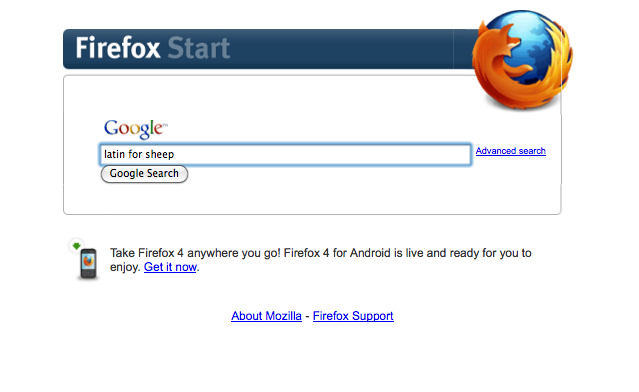

I googled the Latin first.  Dead languages are pretty fantastical, after all.

In amongst all the adverts I found my answer – ‘Ovis Aries’.  Naturally the first two names that came to mind that sound a bit like these were ‘Ovid’ and ‘Archie’ – both of which could work.  Ovid, Roman poet who was very popular in the middle ages, unusual first name which could mark him out as special; and Archie, short for Archibald, a fairly old fashioned name meaning ‘brave’ which this sheep will have to be in order to complete his quest.  Whatever that is.

There was only one thing for it – I had to appeal to the internet for help.
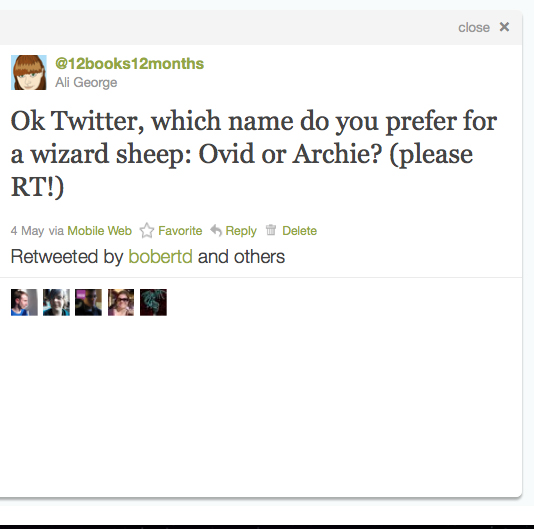
And Twitter spake unto me saying:

And I thought ‘hm, the ideas I have for this are less mystical and aloof and probably more suitable for ten year olds.’  So I went on the facebook page to see whether they were in agreement.
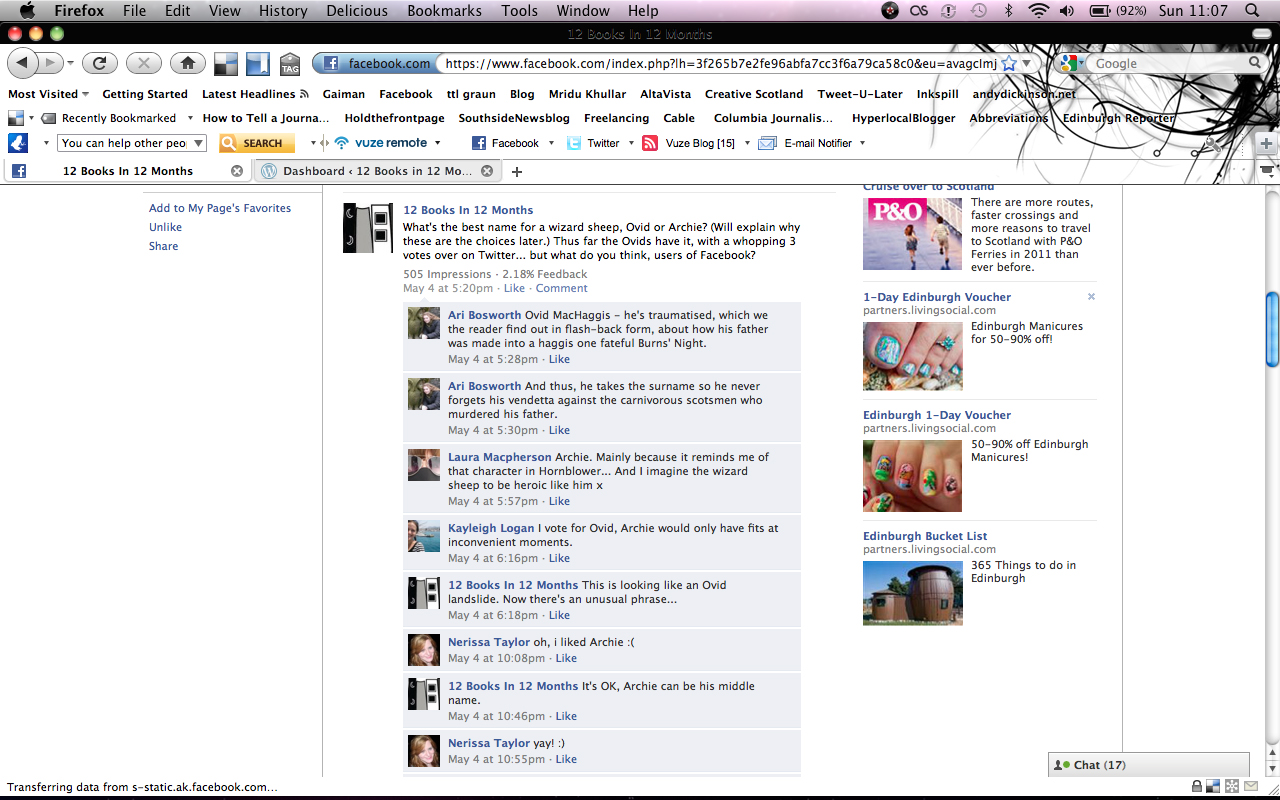
And although the writing was rather small you could see that the Ovid tally rose ever further.

So, for the time being at least, that is what my wizard sheep is called – Ovid Archibald McHaggis.  One wonders how characters were named before the days of the internet.

How do you name your characters, other writers?  Do you have a set process, or is it a bit ad hoc, like me?  And do you ever change a character name half way through writing and then have to go back and check them all?

More Questions

Further questions from Edinburgh-based writer and tweeter Andrew Blair.  I have decided to answer these separately because they’re not really related in any way.

Have you been pleasantly surprised by your research into genre fiction? For example, has Dark Romance proved to be more than pale women kissing vampires?

Truth be told, I wasn’t expecting much from Dark/Paranormal Romance.  I rather thought that most of it had been churned out in a cynical manner to jump on the Twilight bandwagon, and as such I assumed that all such books would be full of unsympathetic teenagers and deeply misogynistic male role models.  My plan was to make the genre readable by imbuing it with my special brand of humour/Scottish realism.

However, I am pleased to report that my suspicions were overly cynical.  The PC Cast excerpts I found online, for example, were much better than expected.  I’d go so far as to say they were entertaining, which is more than can be said for Adventures in Forks as it is seldom known.

Having said that, the main thrust is pretty much pale women kissing vampires.

What do you think of the World Book Night coverage from the BBC, and its putting of Literary Fiction at the forefront?  You remember World Book Night, with Sue Perkins going around hairdressers in Edinburgh and asking people why they hadn’t read Dostoevsky…?

My decision to put off doing Literary Fiction until December was taken at least in part because that meant it was the furthest away.  Putting LitFic at the forefront of anything strikes me as silly, because it automatically alienates a vast section of the reading population who want something a bit more gripping than flowery prose about beautiful landscapes.

I’m not saying I don’t enjoy or appreciate Literary Fiction, but it’s hard going at times.  And I resent the suggestion you get from commentators on some of the programs the Beeb have shown that writing genre fiction means you aren’t as clever or as profound as a literary author – it’s more about storytelling priorities.  Personally, I can forgive a big of unpolished prose if the plot and characterisation keep me interested, whereas LitFic is all about form.

Just out of curiosity, as a writer and bookseller yourself, what do you make of the coverage?

I Have Questions

Further to Monday’s shout out for guest bloggers, for the rest of this week I am answering the queries of Andrew Blair, an Edinburgh-based writer of comedy and other things.  You can see some of his work on this website, or follow him on Twitter @aagb1884.

Tuesday 26/4/11, 08:00

Ali,

I have been reading your blog sporadically. I have questions.

Number 1. You are writing in 12 different genres. This is not a question. What genres of books do you predominantly read and have you enjoyed the experience in researching others? That is a question.

Andrew

Tuesday 25/4/11, 13:01

Andrew,

I don’t really have a favourite genre, although I lean towards books with a sense of humour and quite like things with a fantastical element.  I also like a lot of YA and kids books, and Scottish fiction.

To give some examples: some of the best and funniest books I’ve ever read are the Mr Gum series by Andy Stanton, which I’d recommend to anyone (even though they’re really aimed at 8 year olds).  Meanwhile in fantastical terms, I go from the very dense prose of Isabel Allende to Neil Gaiman‘s Sandman graphic novels with a bit of future dystopia from Aldous Huxley or Margaret Atwood along the way.

In terms of YA, I’ve recently enjoyed stuff by Holly Black and Gemma Malley, as well as The Gates by John Connolly who started out writing adult crime novels.  You can read the first chapter on his website, and I think it’s awesome.

Great kids books I’ve read lately include The Girl Who Could Fly by Victoria Forrester and The Secret Benedict Society by Trenton Lee Stewart.  I’d also recommend Steve Augarde‘s ‘Touchstone Trilogy’ which is suitable for 11+.  Good Scottish novels include The Ossians by Doug Johnstone and The Incredible Adam Spark by Alan Bissett, and anything by Muriel Spark…  Essentially I like to think I’ll give anything a go, and as such my ‘to-read’ list is very, very long.

In terms of research for 12 books, so far I have probably enjoyed the romance month the most because the genre is often unintentionally very funny.  It’s quite rare to find a romance book that is genuinely romantic, I think partly because a lot of authors tend to get caught up in sex scenes – one of the reasons why I decided to go for unrequited love, actually – and these are notoriously difficult to write well.

Ali

Writing Teenagers

I instinctively write the ones I know – moody, foulmouthed and bored all the time.

Well, it’s cool to be bored, innit.

However, I also remember that as a teenager I had long periods where I was actually quite happy, and this presents something of a problem when writing Jennifer, the lead character in my Paranormal Romance/Dark Fantasy title.  Should I allow her any respite from the angsty world of being a lonely vampire?  Should she be allowed to have some friends who accept and even seem to be fond of her, as I did when I was growing up?  Should she occasionally have hyperactive giggling fits when she is showing off in front of a boy she likes?

To turn to the heavyweight of this genre; Bella out of that Twilight book has friends – not that she appreciates them in any way.  All she’s interested in is bedding her sparkly vampire Adonis, and she seems blissfully unaware of the fact that the kids of Forks go completely against stereotyping etiquette by accepting her into their group without question.  She never laughs, or does anything much other than pine after a man a hundred years her senior, who has questionable dietary habits and a sense of humour bypass.

Is this something I ought to be entering in to?  Up to a point I suppose I am trying to write for a YA audience, but I struggle with the concept that teenagers have no sense of fun.  Granted, their concept of fun may be slightly skewed towards setting stuff on fire, picking on the weaker members of the friendship group, or hanging around street corners and shopping centres getting in people’s way… but it isn’t all time spent on the verge of tears over a member of the opposite sex.

Still, some of it is, and that may well be what people want to read about.

Based on the habits of my friends in school and of kids that came into the library where I used to work, part of my trouble is that a lot of teenagers seem to stop reading around the age of 13 and never pick it up again until they’re 19 or 20.  In doing this, they manage to miss out on a lot of brilliant fiction because they go straight from kids books to adult ones.  I tended to read books ‘aimed at teenagers’ between the ages of about 11 and 13, then I went on to more grown up ones.  I only came back to teenage stuff a couple of years ago, as an adult.

All of which makes me wonder who the ‘YA’ audience actually is.  And should my  book encourage people in their mid-teens to keep going, or is it aimed at people in their late teens and early twenties?  Or is it both?  And if so, how do I appeal to the broad range of emotions and experiences that constantly change and evolve over the period of adolescence?

There’s a lot to consider, essentially.  Although ultimately I think I’ll do the same thing I do every time – write as it comes to me and worry about it later.

The editorial process is going to be an interesting one.

Blog at WordPress.com.

Up ↑