Search

12 Books in 12 Months

writing books and blogging about it

Category

writing

Stumbling Round in the Dark

Another week heralds another new questioner keen to know what on earth possessed me to tell everyone I’d write 12 books in 12 months.  The Rogue Verbumancer is a scientist who occasionally masquerades as a writer on the internet, blogging here and tweeting as @Glempy.  Here’s what he had to ask me.

There is one thing that has rather astounded me about your little quest. It’s not so much the writing twelve books thing. That’s a bit mad. It’s an established fact. But it’s only really a surface to the madness. Admittedly knocking out some 600,000 words will be no mean feat, but there is something which I’m finding even more epically daunting. It’s the whole genre thing. I’ve always gotten the impression that writing for a particular genre requires a certain type of thinking and way of doing things. I personally could never even approach the romance genre. Not even with a particularly heavy dose of Dutch courage and a particularly long, pointy stick (Give me knights lopping each other’s limbs of with aforementioned pointy sticks any day). But here you are lunging head long into twelve completely different genres. Is this just a case of some form of prenatural talent granted to you by the strange and unknowable deities of writing? Or something learnt after years of study at the feet of bearded Tibetan writing monks?

Basically, have you discovered some sort of knack that you’re not telling anyone about or are you just stumbling about it the dark with stick?

There were a couple of reasons for changing genre every month.  One was to keep me from getting bored.  Another was to expand my horizons and challenge myself.  And naturally there was an element of cynicism – 12 books in 12 different genres, surely one of them has to be marketable?!

I have been trying to research genres each month, but it turns out I don’t have a lot of time for that what with all the constant writing.  So I think really I’ve just skiffed the surface of most of them.  My hope is to do some proper hardcore reading before I go back to edit the first drafts, so that if I’ve used any horrible cliches I can quickly edit them out before anyone else sees.

So essentially, what I am doing is writing books withing some very broad brushstrokes pertaining to each genre, and my own writing style permeates all of them.  Have I met the needs of each style?  To be honest, I’m not sure.  But I’m not too worried about it.  I read a post on Nicola Morgan’s fantastic blog when I was panicking about Book One (most specifically how accurate it needed to be, as it was historical and at least loosely based on real life) that really inspired me.  This is it here.

What I really took to heart was that with a first draft, all you need to do is sketch everything out.  You can afford to be a bit hazy at this point, on account of knowing you’re going to go back and fill the details in later, having conducted further research.  This makes a lot of sense to me.  After all, my arbitrary word count for each book is 50k, which is 22k short of the average first novel…  I’ve got words to play with, there!  And none of these books are going anywhere as is – they’re first drafts.

I guess that a lot of writers develop specific ways of working, particularly when they’ve been pigeonholed by their publishers into doing one genre.  But at the moment I haven’t fallen into any particular habits, because I don’t have to.  Maybe if someone gives me an advance for a Paranormal Romance, I’ll worry a little bit more.  But until that happens I’ll keep experimenting and having fun within the rough boundaries that each genre seems to inhabit.

Chapter One

If you click below, you can listen to me reading chapter One of book 5, which you may remember is about a wizard sheep called Ovid.  And a small boy called Eric.  And an as-yet unnamed dragon.

I wanted to do the whole first chapter but am apparently limited to 5 minutes, but it’ll give you the general idea.

Let it… penetrate.

Generating Traffic

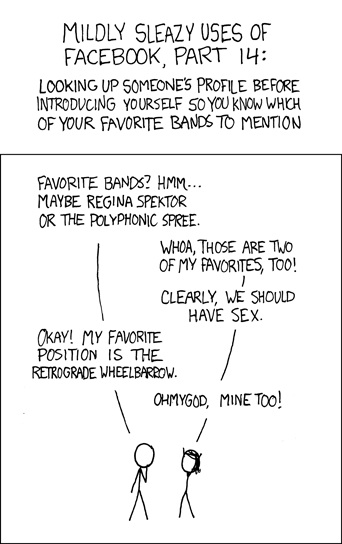
According to an article I read and now can’t find again (I thought it might be on The Social Penguin or Contently Managed but apparently not), links on Facebook generate far more traffic than links on Twitter.  With that in mind, I would like to ask you all to click the ‘like’ button on the 12 Books in 12 Months Facebook page and then to post it to your own stalkerfeed by clicking the ‘share’ button on the left of the page.  It would be pretty good to get 200 fans by the end of the month, and I promise I don’t spam – I update a few times a week.

Image from xkcd

Q&A with Ian Collings

This week I’m chatting to Shropshire based writer Ian Collings, who tweets as @ibc4 and blogs at Take One Step Back.  I’ve split this email into a Q&A format.

Which part of the writing process (condensed as it is into such a short period) do you find the hardest?  The editing? Re-writing? 

Because the writing process is condensed into such a short period with this project, editing and re-writing don’t actually get a look in.  Not yet, anyway.  The plan was to leave all the drafts for a minimum of 3 months before going back to look over them, but so far I haven’t had the time to go back and start editing any.  The hardest part of the writing process with this is therefore the purely practical aspect of fitting in writing time – when I sit down and do it, it’s a race against time to get the words out there so I just write and write, even if some of it’s nonsense.  These first drafts are littered with asides like “she said, by way of exposition,” which all add to the word count!  But generally speaking I think editing and re-writing are much harder work.

Secondly, have you ever wanted to ‘throw in the towel’ and walk away from  twelve books in twelve months?  Or, rather just concentrate on one through to publication there and then?
So far I haven’t wanted to walk away from the project at any point, although I’ve had to let go of the notion that I’ll make the 50k word count every time.  I think because I haven’t given myself the opportunity to get bored of it or even to get stuck by overthinking (there’s no time to think, after all!) that’s made it quite easy to keep going.  If I was reading back over it all the time I’d probably feel a crushing sense of doom about how much work there is still left to do on all of them, but the no-editing rule means I can just go yeah, I’ve written most of a book, go me! Now onto the next one!
How have other writers supported you? Have any derided your ‘project’?
Nobody has derided the project, although Debbie Taylor (Editor of Mslexia and author of The Fourth Queen) was a bit disbelieving when I told her about it at first.  She tends to write for a maximum of about a fortnight before having to take a break from it.  I haven’t really talked to a lot of authors about it yet though, although my intention is to do a series of author interviews on how they approach writing for book 13 (the one where I write about writing 12 books in 12 months).  Ian Rankin wished me luck on Twitter at the very beginning, which was kind of him, and I know from an interview I read with him that he drafted the first Rebus book in about a month – the difference there being that he didn’t then do the next 11 in quick succession, I guess!

I’ve had a lot of support from other people though, especially on Twitter.  The general consensus seems to be that it’s a slightly mad thing to do, but in a good way!

And finally, for today only, if you could take the credit for writing any book from the last hundred years, which would it be? Which of your current works in progress most resemble it?
The book I’d like to take credit for writing… brilliant question.  A difficult one, as well – there are lots.  I think maybe The Book Thief, by Marcus Zusack, because it was so clever and well written and made me cry – which is really rare, actually.  None of my books resemble it in the slightest, though!

Writing Style

This week I’m answering questions from Ian Collings, a writer based in Shropshire who blogs at Take One Step Back and tweets as @ibc4

Of the twelve books you’re writing which falls into your natural writing style the most? Which do you find the easiest to pick up?

My natural style tends towards the silly, often by accident, and even though I haven’t written a kids’ book yet, I’ve harboured ambitions to be a children’s author for about ten years… Essentially I forsee July’s book as being the best – or at least the most enjoyable to do!  That or fantasy, actually.  I’ve written a bunch of short stories that fall across both of those fields and have probably read a lot more of those than any other type of book.

I would love to strike a balance between well written, engrossing but often humorous fantasy written by Neil Gaiman / China Mieville and the silliness of Spike Milligan (whose picture book for little kids, Sir Nobonk, is one of my favourite books ever), with an element of the dark or unexpected twists that you get in Roald Dahl.  And I think May and July’s fantasy and kids’ books are the ones where I’ll be able to give that a proper try.

How To Name A Character

I often come up with character names ahead of their personalities.  Not always, but often.

But when someone else comes  up with your character for you, it’s a little bit harder to name them.  I am in the process of writing book five, and before I started I had a suggestion from the lovely Arielle Bosworth (click her name to go to her blog) that “your protagonist should be a talking sheep who is also a wizard. It could be amazing.”

She went on to explain, quite rightly, that “sheep are entirely unrepresented in the fantasy genre.”  And if I don’t rectify this glaring omission, who will?

However, I had to then come up with a name for this character.  So I thought about it a bit, and decided perhaps I would gain some insight from looking up ‘sheep’ and ‘wizard’ in other languages.  This is what transpired:


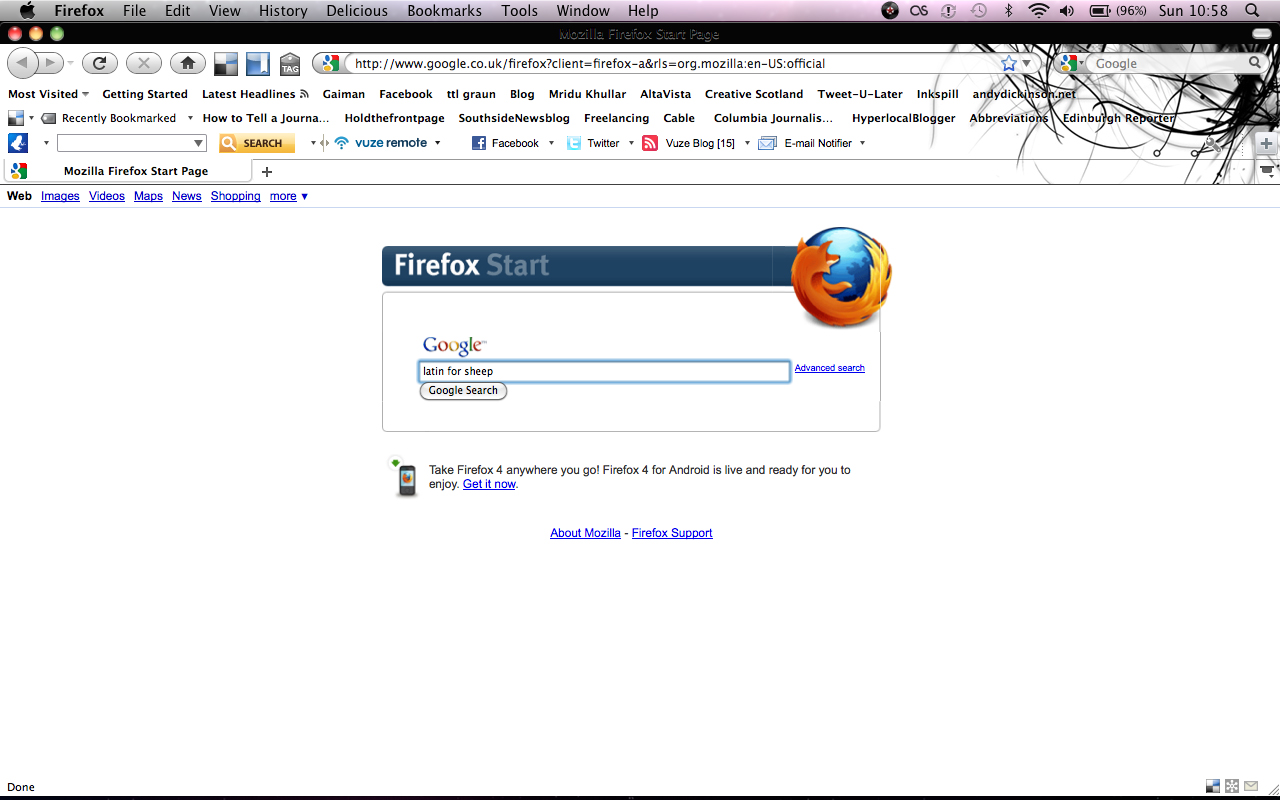
I googled the Latin first.  Dead languages are pretty fantastical, after all.

In amongst all the adverts I found my answer – ‘Ovis Aries’.  Naturally the first two names that came to mind that sound a bit like these were ‘Ovid’ and ‘Archie’ – both of which could work.  Ovid, Roman poet who was very popular in the middle ages, unusual first name which could mark him out as special; and Archie, short for Archibald, a fairly old fashioned name meaning ‘brave’ which this sheep will have to be in order to complete his quest.  Whatever that is.

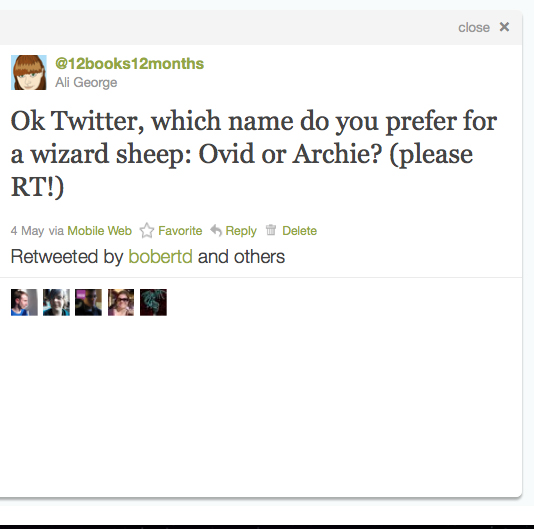
There was only one thing for it – I had to appeal to the internet for help.

And Twitter spake unto me saying:

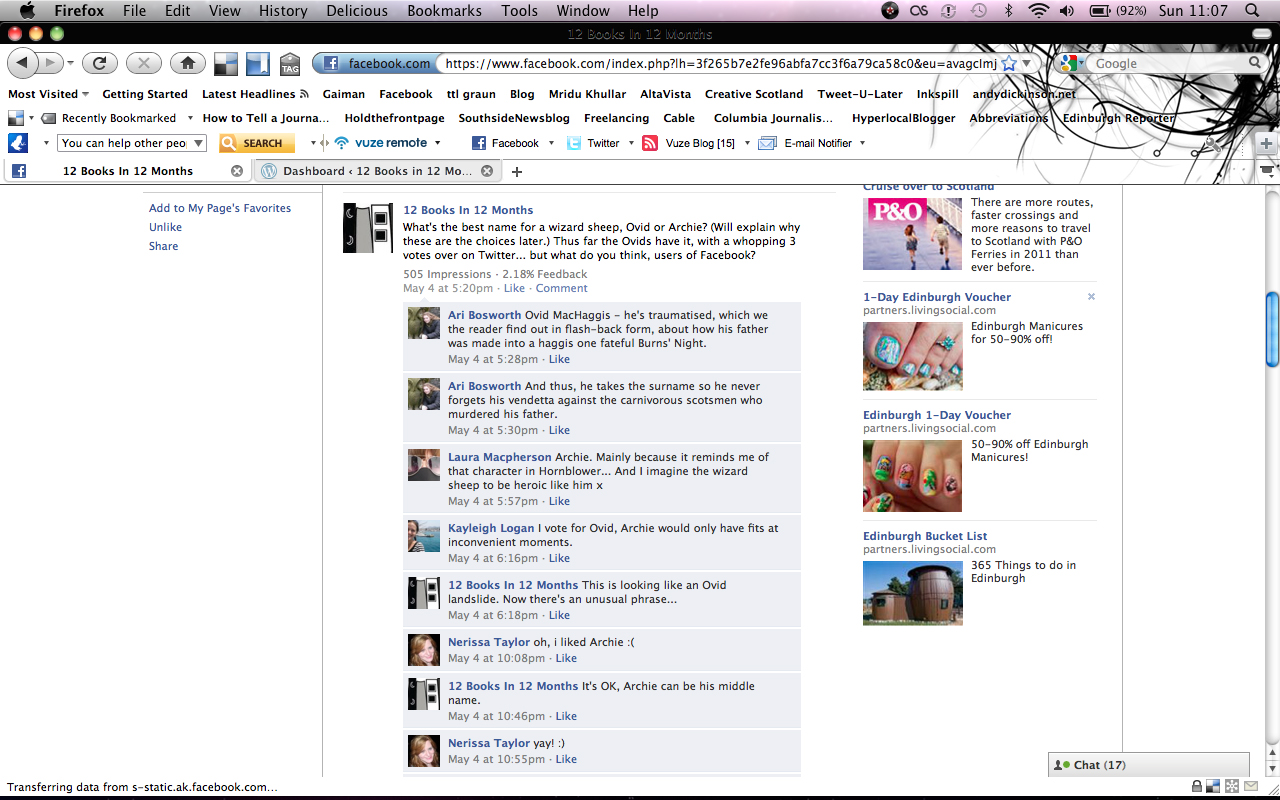
And I thought ‘hm, the ideas I have for this are less mystical and aloof and probably more suitable for ten year olds.’  So I went on the facebook page to see whether they were in agreement.

And although the writing was rather small you could see that the Ovid tally rose ever further.

So, for the time being at least, that is what my wizard sheep is called – Ovid Archibald McHaggis.  One wonders how characters were named before the days of the internet.

How do you name your characters, other writers?  Do you have a set process, or is it a bit ad hoc, like me?  And do you ever change a character name half way through writing and then have to go back and check them all?

Blog at WordPress.com.

Up ↑