Search

12 Books in 12 Months

writing books and blogging about it

Category

socialnetworking

Q&A with Ian Collings

This week I’m chatting to Shropshire based writer Ian Collings, who tweets as @ibc4 and blogs at Take One Step Back.  I’ve split this email into a Q&A format.

Which part of the writing process (condensed as it is into such a short period) do you find the hardest?  The editing? Re-writing? 

Because the writing process is condensed into such a short period with this project, editing and re-writing don’t actually get a look in.  Not yet, anyway.  The plan was to leave all the drafts for a minimum of 3 months before going back to look over them, but so far I haven’t had the time to go back and start editing any.  The hardest part of the writing process with this is therefore the purely practical aspect of fitting in writing time – when I sit down and do it, it’s a race against time to get the words out there so I just write and write, even if some of it’s nonsense.  These first drafts are littered with asides like “she said, by way of exposition,” which all add to the word count!  But generally speaking I think editing and re-writing are much harder work.

Secondly, have you ever wanted to ‘throw in the towel’ and walk away from  twelve books in twelve months?  Or, rather just concentrate on one through to publication there and then?
So far I haven’t wanted to walk away from the project at any point, although I’ve had to let go of the notion that I’ll make the 50k word count every time.  I think because I haven’t given myself the opportunity to get bored of it or even to get stuck by overthinking (there’s no time to think, after all!) that’s made it quite easy to keep going.  If I was reading back over it all the time I’d probably feel a crushing sense of doom about how much work there is still left to do on all of them, but the no-editing rule means I can just go yeah, I’ve written most of a book, go me! Now onto the next one!
How have other writers supported you? Have any derided your ‘project’?
Nobody has derided the project, although Debbie Taylor (Editor of Mslexia and author of The Fourth Queen) was a bit disbelieving when I told her about it at first.  She tends to write for a maximum of about a fortnight before having to take a break from it.  I haven’t really talked to a lot of authors about it yet though, although my intention is to do a series of author interviews on how they approach writing for book 13 (the one where I write about writing 12 books in 12 months).  Ian Rankin wished me luck on Twitter at the very beginning, which was kind of him, and I know from an interview I read with him that he drafted the first Rebus book in about a month – the difference there being that he didn’t then do the next 11 in quick succession, I guess!

I’ve had a lot of support from other people though, especially on Twitter.  The general consensus seems to be that it’s a slightly mad thing to do, but in a good way!

And finally, for today only, if you could take the credit for writing any book from the last hundred years, which would it be? Which of your current works in progress most resemble it?
The book I’d like to take credit for writing… brilliant question.  A difficult one, as well – there are lots.  I think maybe The Book Thief, by Marcus Zusack, because it was so clever and well written and made me cry – which is really rare, actually.  None of my books resemble it in the slightest, though!

Writing Style

This week I’m answering questions from Ian Collings, a writer based in Shropshire who blogs at Take One Step Back and tweets as @ibc4

Of the twelve books you’re writing which falls into your natural writing style the most? Which do you find the easiest to pick up?

My natural style tends towards the silly, often by accident, and even though I haven’t written a kids’ book yet, I’ve harboured ambitions to be a children’s author for about ten years… Essentially I forsee July’s book as being the best – or at least the most enjoyable to do!  That or fantasy, actually.  I’ve written a bunch of short stories that fall across both of those fields and have probably read a lot more of those than any other type of book.

I would love to strike a balance between well written, engrossing but often humorous fantasy written by Neil Gaiman / China Mieville and the silliness of Spike Milligan (whose picture book for little kids, Sir Nobonk, is one of my favourite books ever), with an element of the dark or unexpected twists that you get in Roald Dahl.  And I think May and July’s fantasy and kids’ books are the ones where I’ll be able to give that a proper try.

How To Name A Character

I often come up with character names ahead of their personalities.  Not always, but often.

But when someone else comes  up with your character for you, it’s a little bit harder to name them.  I am in the process of writing book five, and before I started I had a suggestion from the lovely Arielle Bosworth (click her name to go to her blog) that “your protagonist should be a talking sheep who is also a wizard. It could be amazing.”

She went on to explain, quite rightly, that “sheep are entirely unrepresented in the fantasy genre.”  And if I don’t rectify this glaring omission, who will?

However, I had to then come up with a name for this character.  So I thought about it a bit, and decided perhaps I would gain some insight from looking up ‘sheep’ and ‘wizard’ in other languages.  This is what transpired:


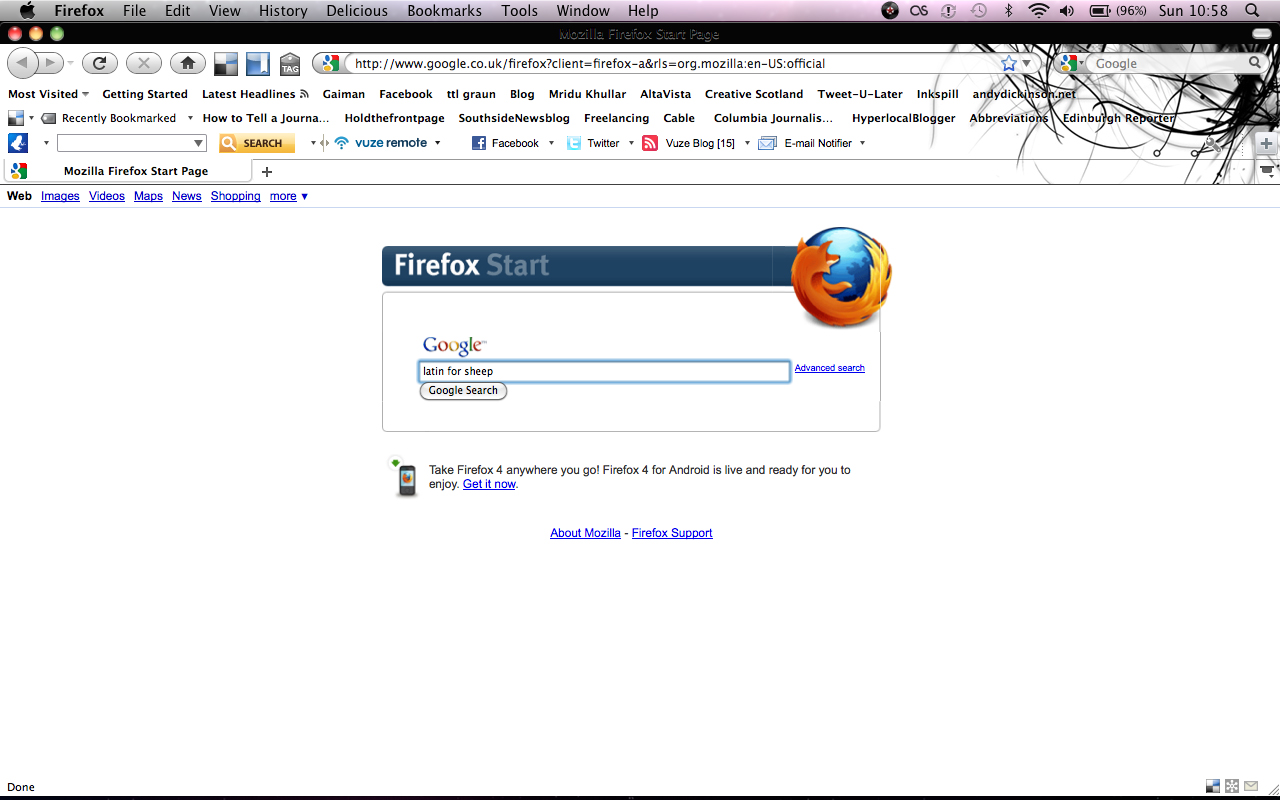
I googled the Latin first.  Dead languages are pretty fantastical, after all.

In amongst all the adverts I found my answer – ‘Ovis Aries’.  Naturally the first two names that came to mind that sound a bit like these were ‘Ovid’ and ‘Archie’ – both of which could work.  Ovid, Roman poet who was very popular in the middle ages, unusual first name which could mark him out as special; and Archie, short for Archibald, a fairly old fashioned name meaning ‘brave’ which this sheep will have to be in order to complete his quest.  Whatever that is.

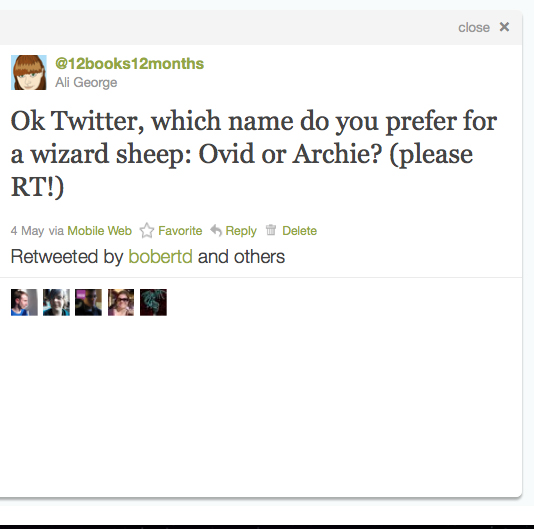
There was only one thing for it – I had to appeal to the internet for help.

And Twitter spake unto me saying:

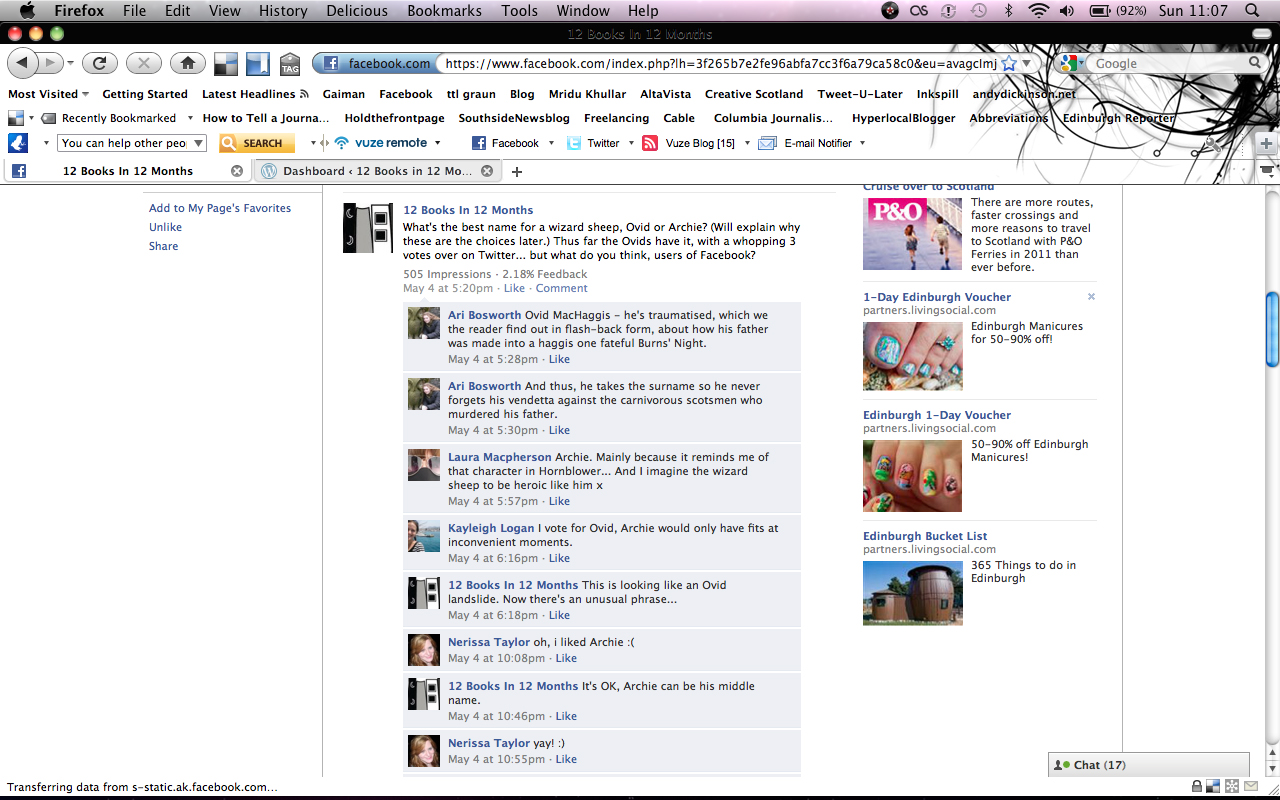
And I thought ‘hm, the ideas I have for this are less mystical and aloof and probably more suitable for ten year olds.’  So I went on the facebook page to see whether they were in agreement.

And although the writing was rather small you could see that the Ovid tally rose ever further.

So, for the time being at least, that is what my wizard sheep is called – Ovid Archibald McHaggis.  One wonders how characters were named before the days of the internet.

How do you name your characters, other writers?  Do you have a set process, or is it a bit ad hoc, like me?  And do you ever change a character name half way through writing and then have to go back and check them all?

Writer’s Block

My last email from Edinburgh blogger Elaine from Dreams and Whispers covers the tricky subject of the creative block…

My last question is about creative writing in general, and blocks that can hinder creativity -for example perfectionism, comparing your work to others, an internal critical voice, etc. Personally I got stuck when I attempted Nanowrimo last year: I’d think “Ugh, that last sentence was horrible, I can’t possibly leave that in. I’ll just go over that for a second…”, then suddenly a whole paragraph would be edited and the word count would actually reduce! So my question for a prolific writer like yourself is: do you ever get stuck with “writer’s block” and if so, what helps you move past it?

I think everyone gets creatively blocked from time to time.  I’ve lost count of the number of blog posts and tweets I’ve read that claim sitting in front of an empty page or screen is the hardest part of the writing process.  But to be honest, I don’t find it to be as much of a problem as I used to.  I found it incredibly hard to write fiction when I was at uni and only finished a few things. For those four years I blogged (although not as regularly as now) and did journalism (mainly singles reviews and occasional comment pieces) and spoof news stories for the uni satirical paper… but I rarely finished any stories.

After graduating in 2008 I continued that trend for a bit.  By that point I had sort of decided that my fiction style was a bit too flippant or glib for anyone to really care about, but I continued with blogging and started to write news stories and stuff for hyperlocal websites.  So yeah, I have been known to go ‘no, I can’t do it, and even if I did have an idea I wouldn’t do it justice..’

So I merrily continued with short articles and blog posts till November 2009, my first go at NaNoWriMo.  What I liked about NaNo was that they recognise this tendency people have to lose confidence in what they’re doing, like me, or as you mentioned in your email, to start but then sit and get stuck, re-reading and editing and worrying about it all  and never getting anything done and eventually giving up and moving on to something else.  As you know, that is why they set the 50k in 30 days challenge – the idea being that you do not physically have time to stop and go back over stuff because you have to get at least 1,667 words written every day as well as going about your daily business.  In order to get there you need to accept that a certain amount of stuff will in all likelihood not be very good, and do it anyway – you can go back and fix it later.
Although I didn’t finish in 2009 because work was insane, I got about 15k done and I think I was cured of the notion I’d developed that fiction wasn’t for me.  I also had a strong sense that I probably would have finished if a couple of specific and relatively unusual incidents at work hadn’t got in the way.  Which is good, because the whole time I was growing up “author” was one of my top career choices, refined to “children’s author” when I went to high school.  Then when I reached the age of 15 and realised “author” was unlikely to be my first job, I decided to go for “journalist” and then segue once I had ten years or so of writing for a living under my belt.

NaNo 2010 cured me completely I think.  I guess I’d been resolving to do it for a year, mulling over these ideas of not editing and just writing anything that comes to mind, so by the time it came around it didn’t even occur to me to read back over what I’d done already!  I do genuinely think of editing as a totally separate entity to the initial writing process now, and with 12 books I quite often don’t read back over anything at all.  In fact there are only two scenarios when I read things over again: when I haven’t written for a day or two and can’t quite remember where I left off, or when I’m putting an excerpt on the blog – because I do read back over blog posts and edit them a bit before putting them up.

It also reminded me not to take myself too seriously.  There is no freaking way that the first draft of any novel is going to be the next Moby Dick, War and Peace, or whatever, regardless of how much you’ve planned and researched.  There’s no point in panicking because it isn’t perfect, because if you’re going to give up after the first draft you probably aren’t that passionate about it.  Crafting something literary takes time and effort – writing is a job and you have to work at it.  And anyway, those aren’t the sorts of things I want to write – you remember I said I convinced myself nobody would want to read my stories because they tend towards the silly or glib – but then I thought actually, I’d read them.  I like books that make me laugh, and I can’t be the only one.  Otherwise Terry Pratchett would be out of a job.

12 books has continued the good work of NaNo in helping with creative blocks.  It means I have to force myself to write, to the extent that it feels odd if I haven’t done anything that day, and when I get into the way of it I can get a lot done in one sitting – my WPM has definitely got quicker over the past few months!  And because I’m doing one a month, plus a lot of other short articles at the same time for other blogs and websites on different topics, I never have the chance to get bored with any of them.  I still get frustrated, but that’s often as much because I know exactly how I would fix things if I had the time to do a bit more research or whatever.

Trying to publicise it has also forced me to talk about what I’m doing, which can help a lot when you’re stuck.  I used to be very anxious about sharing anything before it was finished – I couldn’t even sit next to my boyfriend writing out a blog post on my laptop because I felt like it was raw and unfinished and if he happened to read any over my shoulder he would be thinking ‘well that isn’t very good’.  He wouldn’t, of course, but I was paranoid anyway.  But with 12 books I have to talk about it so that people will give me suggestions, and I’ve done a couple of interviews with local news sources about it too, which has helped me lose that fear of somehow failing or people thinking badly of me.  And also, talking about a story and the problems you’re having with it out loud quite often gives you ideas of how to fix it yourself, even before other folk jump in with their suggestions.

The other thing that helps creative blocking is reading lots.  I know it can make you despair at times because you feel there’s no way you’ll ever be as good as whichever author has captured your imagination on any given day, but it can also help you decide who to emulate and who to avoid, it gives you ideas about how you would approach something, and it all feeds in to the imagination lobe of your brain (I don’t think it’s called that but there must be a bit that deals with that type of stuff) and stews in there and recycles itself into new ideas and a better writing style.  It can also make you insanely jealous that someone else has created something so awesome, which can be quite motivational :p

The main thing I would say though is to never ever beat yourself up about not having written anything.  If I was doing that this project would have been over before it began.  Feeling a bit blocked is fine and normal, and it’s OK to give yourself a few days off.  The thing about writing is that even when you aren’t physically doing it, ideas are probably floating around in the back of your mind, whether you’re conscious of them or not.  It’s alright to not get anything down for a while.  But, if you suspect that it’s less a case of not having anything to write and more about being lazy, then just sit down and start.  Start in the middle, or at the end, or with a generic ‘Once upon a time’, and write whatever the hell comes into your head, for at least ten minutes.  Chances are you’ll get into it and keep going for longer than that.  Don’t worry that you have nothing to say – everyone has something.  Something they like or hate, or that they think everyone else should know about; a terrible secret of their own or someone else’s; a funny anecdote; a hope or aspiration.  And if it turns out when you’ve written a few hundred words that actually that isn’t what you wanted to say, that’s OK.  It’s a first draft and it’s up to you whether anyone ever gets to see it.  Just don’t delete it till you’ve gotten the thing you actually meant to say out there on the page.  And backed up.

Which One Will You Choose..?

It’s the third day of questions courtesy of Elaine from the Dreams and Whispers Blog, and she asks something I’ve never really thought about before… to choose which of my children I love the most!

Today’s question is about the characters in your books. For me as a reader, I find that interesting characters can really make a book brilliant. With you being on your fifth book now, you must have invented and thought about a fair few people, so which of them stand out the most – which two have been your favourite and least favourite so far?

I agree with you that characterisation can make or break a book.  Good characters stay with you and you want to find out more about them – this is presumably why so many authors write in series.  Whereas bad ones can make it difficult to carry on reading (although I’m pretty tenacious – it’s rare that I don’t drag my way kicking and screaming to the end of a book).

So far my favourite character is probably Caligula, if I can legitimately claim him as a character!  I enjoyed trying to get into his mind and second guessing why he did the crazy things that he was meant to have done – that’s the revisionist historian in me trying to come out, I think.  The sources on Caligula are fantastically biased but it makes for interesting reading.

I have a lot of affection for Victor McGlynn as well – he was the main character in the Western and I gave him quite a rough time of it with a pretty sad back story and a not amazing here and now, but he coped with dignity!  I am also really looking forward to writing the main characters in my kids’ book in July, because I’ve been developing them in my head for about two years.

There aren’t any characters I haven’t enjoyed writing at all, but I suppose my least favourite is Jennifer, the protagonist of the last book.  This is partly because I swithered an awful lot over how to write her – this has been the most difficult book so far.

I was trying to write her as a stroppy teenager but I think I may have gone a bit overboard with her lack of empathy and self involvement, so I’ll have to sort that out when I go back to edit it!  Think I should make her a bit more likeable!  Although having said that, Stephanie Meyer didn’t bother making Bella likeable and she did alright.  Maybe I’ll just leave it….

Inspiration

A second email from Elaine of Dreams and Whispers fame.

Next I would like to find out a bit more about your inspiration for the twelve books – did you already have ideas before you started, or are you taking it book by book and seeing what develops for each one? As you write, do you find that most of your theme/plot/character ideas are coming from things you encounter in life, people you meet, your imagination, or somewhere else?

I had a few ideas before starting, many of which are laid out on the ‘Get Involved‘ page and in the Facebook photo album.  I went into it with the hope that members of the public would challenge me by giving me different suggestions to incorporate as I went along, giving the project a more interactive feel but also forcing me to plan things so that I’d include all their ideas.

As it happens, I think a lot of people find it intimidating to have me say ‘just suggest anything at all’.  For instance with book 2, where I got suggestions from staff at The Byre Theatre in St Andrews, basically everything I got was anecdotal stuff about working in a theatre.  Nobody seemed interested in motive, murder weapon, or red herrings, and I ended up going on Twitter when I’d already started writing to ask people to suggest names for characters I’d just invented.  This meant that the book developed much more out of my own brain than I think I expected.

At the other extreme, with the Western story I got a very in depth story suggestion from someone, but I ended up not using it because it would have required an awful lot of historical research on my part – the suggester obviously knew quite a bit of the history of the west and had some very specific ideas, which frankly I felt a bit dodgy about using!  So hopefully he will write it himself one day!  It helped me though, because when I read it I realised that a traditional story like that was the exact opposite of what I wanted to do, and came up with what I think was quite a strong idea to work from.

For paranormal romance I think the only suggestion I got was a name and occupation for the central character.  I used the name, Jennifer, but changed the occupation very slightly.  I hadn’t planned for it to be paranormal to begin with, and was hoping to do quite a bittersweet story.  I changed my mind to challenge myself – I’ve never quite got the appeal of paranormal romance and have slagged it off a bit, so I thought why not put my money where my mouth is and see if I can do any better.  With all that dithering, though, it probably wouldn’t have made a difference if people had suggested things or not – I had a definite, but at the same time very woolly, plan!

This month is fantasy, and I’ve had a couple of pretty good suggestions for that – clearly it’s a genre that readers of this blog can relate to!  But even then they’re basically character suggestions, so it’ll be me that thinks of the plot, dialogue, narrative and so on.  That sounds like a complaint – it isn’t!  I love making things up – this would be a very strange project to be doing if I didn’t.

I am definitely taking it book by book.  I have to, really.  So far there hasn’t been time to plan any further ahead than that, and in most cases I’ve not even written an outline till I’ve got about 20k in.

None of my characters are directly based on anyone real, but there are elements of dialogue and characterisation which do draw a lot from encounters I’ve had or exchanges I’ve heard in real life.  The first line of my first book, for instance, was, “Nah mate, that’s lies!” because it was something I heard every single day from the kids that came in to my place of work.  For some reason most of my settings have been Scotland so far as well, although that was quite unintentional.

Having said that, I don’t think there’s a huge amount of point in ‘writing what I know’ verbatim.  I recently read an interview with Susan Hill in Mslexia Magazine where she pointed out that the whole point of reading fiction was to escape from the mundanity of every day life, so of course you should write everything from the imagination.  Who really cares about a character who is trying to make it as a freelance journalist whilst also writing fiction and occasionally arguing with her boyfriend about whose go it is to do the dishes?!  But occasionally real stuff bleeds through – hopefully funny, insightful or interesting things, though!

Blog at WordPress.com.

Up ↑